A Newsletter from The Perception Brief™ Series
Why I Dislike Texting—Especially for Business
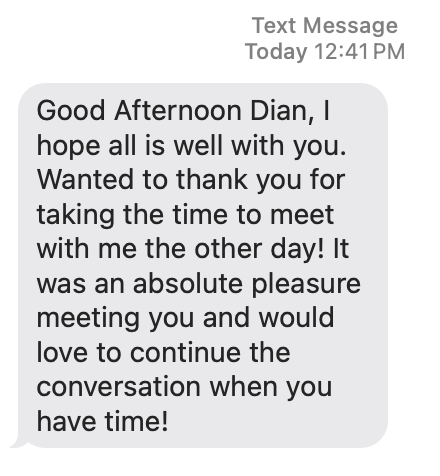
I received a text the other day that read:
“Good Afternoon Dian, I hope all is well with you. Wanted to thank you for taking the time to meet with me the other day! It was an absolute pleasure meeting you and would love to continue the conversation when you have time!”
It was warm. Polite. Complimentary.
There was only one problem:
I had absolutely no idea who sent it.
There was no name. No company. No mention of where we had met, what we had discussed, or why we might want to continue the conversation.
Perhaps the sender assumed I had saved the number. Perhaps they thought the details of our meeting were so memorable that I would immediately know who they were.
I didn’t.
And because unidentified texts can just as easily be spam, phishing attempts, wrong numbers, or the beginning of some strange solicitation, I will not respond.
This is one of the many reasons I dislike texting — and why careless texting can become a mega business mistake.
The sender may be perfectly legitimate. We may have had a productive conversation. There may even be a valuable reason for us to reconnect.
But none of that matters if I cannot identify the person contacting me.
Business communication should never make the recipient solve a mystery. Actually — same applies for personal texting!
“Who is this?”
“Where did we meet?”
“What did we discuss?”
“Is this even real?”
Every unanswered question creates friction. And every bit of friction makes a response less likely.
People are busy. They meet many people. They receive countless emails, calls, texts, direct messages, invitations, alerts, and solicitations. They are also increasingly cautious about unfamiliar numbers.
It is unreasonable to expect someone to recognize you from your writing style, your area code, or a vague reference to “the other day.”
A more effective text would have said:
“Good afternoon, Dian. This is John Smith from ABC Capital. We met Tuesday at the Hudson event and spoke about your insurance needs. Thank you again for taking the time to talk with me. I enjoyed meeting you and would welcome the opportunity to continue our conversation.”
That message gives me what I need.
I know who the sender is.
I know where we met.
I know what we discussed.
I know why they are following up.
Most importantly, I can respond without wondering whether I am engaging with a stranger, a scammer, or someone whose number I failed to save.
This may seem like a minor oversight. It isn’t.
Small communication mistakes shape big perceptions.
Failing to identify yourself can make you appear careless, overly familiar, presumptuous, or unaware of the demands on another person’s attention. None of those impressions helps build trust.
The message itself may be gracious. But when the recipient has no idea who sent it, the intended warmth disappears and is replaced by uncertainty.
And uncertainty rarely inspires action.
The basic rule is simple:
Never make people work to figure out who you are, why you are contacting them, or what you want.
Identify yourself every time—particularly when initiating a new business relationship or following up after a first meeting.
Texting may be fast, but speed is not the same as clarity.
And in business, a message that cannot be confidently answered is often a message that will not be answered at all.
Need to communicate better personally or professionally? Feel free to give me a call. 212.825.3210


