
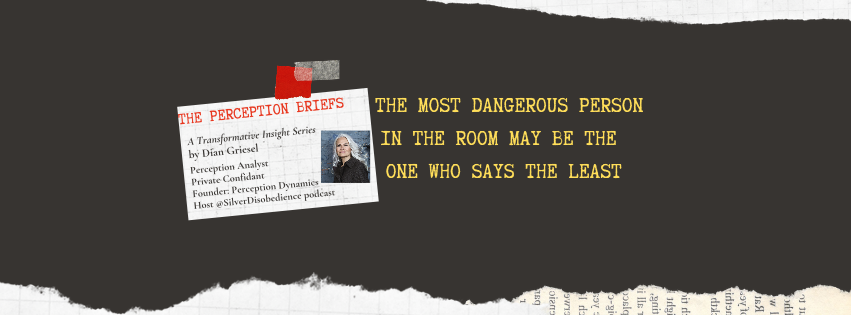
We are conditioned to watch the loudest person in the room. The one who dominates the conversation. The one who interrupts. The one with the strongest opinions, the sharpest objections, the biggest personality, or the most obvious agenda.
But after decades of sitting in rooms where consequential decisions are being made, I’ve learned to pay just as much attention to the person who says almost nothing.
Silence speaks and it is best not confused as disengagement. Sometimes it is observation. Sometimes it is restraint. Sometimes it is calculation. And sometimes the quiet person who appears least influential in the moment, is silently collecting more information than anyone else in the room.
Silent observation can be very powerful because it’s most informative. While everyone else is busy performing, persuading, defending, impressing, explaining, or reacting, the quiet person may be doing something much more useful: consciously watching.
With silence, an observer can notice who needs approval. Who becomes defensive when challenged. Who keeps glancing at whom before answering. Who is genuinely confident and who is compensating. Which subjects cause the energy in the room to shift. Which questions are carefully avoided. Which alliances are real and which ones exist only when everyone is in the room watching, but changing the moment the door opens and everyone exits.
If well-trained, intuitive or astute enough, the silent observer may also be noticing something even far more important: Exactly what nobody is saying.
And this is where perception, as a skill of interpretation, becomes particularly powerful.
How We Assign Meaning
Humans are sentient being. As such, both consciously and unconsciously, we have the ability to sense our environments and experience physical and/or emotional feelings. Whether we are aware of it or not, we perceive these sensations and naturally assign meaning to visible behaviors as well as the sensations experienced within our own physicality such as how our bodies move towards or away from another; a tightening in our chest; shorter breaths; sudden hot sweats or clammy palms; and, so on. Likewise, if someone speaks forcefully, the assumption is often to defer to their authority. If someone talks constantly, we may assume they understand the issue. If someone confidently presents a position, others may begin responding to that confidence rather than examining the underlying substance and facts.
Conversely, silence offers fewer clues. And when we don’t have enough information about someone, due to their silence, we tend to start filling in the blanks ourselves.
The list of go-to assumptions is long. They can be both positive and negative. We may assume the quiet person agrees. We may assume they are intimidated. We may assume they have nothing to add. We may assume they are distracted, passive, inexperienced, uncomfortable, or simply along for the ride.
Every one of those assumptions is a projection of our inner experience. Every one of those assumptions can also be extraordinarily expensive because the person who has not declared a position, other than silent observation, still possesses something everyone else may have already surrendered: Their optionality.
The silent observer hasn’t shown you or others exactly what they think. They haven’t revealed what matters most to them. They haven’t necessarily exposed their leverage. And they haven’t given you much information about how they might act next.
This is why silence is power. Silent observation creates an intriguing imbalance worth exploration and understanding.
The people speaking freely may believe they are controlling the room because they are controlling the conversation. But every sentence they offer provides information to those who listen and observe. The priorities of those speakers become clearer. Their sensitivities surface. Their preferred outcomes become easier to identify.
Meanwhile, the person who is observing and listening is accumulating data without necessarily giving much away. And this is why silence can be such a powerful position in negotiations, boardrooms, interviews, legal disputes, family conversations, and even intimate relationships.
Silence in itself is not inherently a strategic move. But because we frequently underestimate people when they aren’t actively demanding our attention, the power lies in perception errors by others, (think of that as “interpretation errors”) that tend to happen precisely because we confuse visibility and vocality with influence.
Silence is Not a Diagnosis of the Situation, Nor of the Quiet Person
There is an important distinction to note about silent parties in any conversation or negotiation: Not every quiet person is calculating. Silence should not automatically be assumed to be manipulation.
People consciously choose to remain silent and sometimes they unconsciously do so for a variety of reasons. Sometimes someone is silent because they are uncertain. Sometimes they are intimidated. Sometimes they are trying to understand something. Sometimes they are angry. Sometimes they are bored. Sometimes they are afraid that if they start talking, they will say something they regret. Sometimes they simply prefer to listen.
Silent people can make others uncomfortable for any number of reasons. Listeners may or may not even be aware of what specifically is making them uncomfortable because of thoughts, emotions and beliefs that are subconsciously buried deep within themselves that are quite likely unrelated to the present moment, though it may feel familiar. Typically, this may include unresolved feelings of abandonment, disrespect, being ignored, less than, and more. This is where perception can easily become projection.
Whether we think we have high self-esteem or low self-confidence, silence causes people to observe a behavior, then proceed to immediately assign a motive to it.
The assumptions are endless: “He’s being strategic.” • “She’s furious.” • “He doesn’t understand.” • “She’s checked out.” • “He agrees with us.” • “She (or He) is just a manipulative jerk.”
Maybe. All of these assumptions are just big maybes. It would be more accurate to see and recognize silent behavior as evidence, and consider that there could be any number of reasons for it.
One of the most useful habits I’ve developed and apply to my work (and life) daily is having learned to separate what I can actually observe from the story my mind wants to attach to it. In other words, I have become skilled, due to plenty of practice, to become a more objective observer and listener vs. a subjective or emotion-filled one.
You can learn to observe that someone has spoken twice during a two-hour meeting. But, you cannot automatically know why.
You can observe that someone looked away when a particular subject was raised. But you cannot automatically conclude that they are hiding something.
You can observe that someone waited until everyone else had spoken before offering an opinion, but you cannot automatically know whether that reflects confidence, caution, politics, habit, personality, or something else.
The danger of communication breakdowns elevates not because we notice silence and these related behaviors: The danger rises when we start becoming too certain about what they mean.
The most powerful people are observers who remain curious longer than everyone else.
Instead of asking, “What does this prove?” or the more defensive, go-to question, “What are they trying to prove?” they ask themselves, “What might this information mean?” That small shift in how we observe others can keep perception — our unconscious and conscious collective of thoughts, feelings, beliefs and sensory information — from hardening prematurely into judgment.
Watch What Happens After the Silence
One of the best ways to understand a quiet person is not to focus exclusively on their silence. There is actually far more information available when watching what happens when they finally speak. The subtle changes in the room: Do other people stop talking? Does someone immediately begin defending a position? Does the quiet person ask a question rather than make a statement? And perhaps most importantly: What kind of question does that previously quiet person ultimately ask?
A person who has listened carefully for forty-five minutes can sometimes ask in one sentence the very question that exposes the entire structure of a problem. They are capable of doing this not because the question is brilliant in some theatrical way, but because they have had something everyone else denied themselves: Time to observe the whole system of conversation, including the words and body language spoken. While everyone else was inside the conversation, the silent observer was watching it.
I’ve been asked countless times by my clients to act as the “fly on the wall.” To join them in meetings to observe, though not necessarily comment or share any thoughts during a high-stakes situation. I’m there as a member of their team, but my role is to pay attention to everything happening, including who’s speaking up; who’s not; and, to assess the person who ultimately asks the questions that everyone else seems reluctant to ask – or, to propose these very questions based on my observations of the players in the room.
This may include uncomfortable questions like: “What happens if we’re wrong?” • “Who actually has the authority to approve this?” • “Why hasn’t the client been told?” • “What are we assuming here?” • “Who benefits if we do nothing?” • “Why are we rushing?”
Questions like these can sound almost annoyingly simple, yet they are often anything but, because a good question can expose an assumption, that an hour of argument never reached.
The Quiet Person May Also Be the Decision-Maker
There is another reason to pay attention to the quiet in the room and this is the paramount confirmation that influence and visibility are not the same things. Every organization, family, partnership, boardroom, and social structure has an official hierarchy. And then it has a real one. Those two structures overlap far less often than people imagine.
The person with the most impressive title may not be the person whose opinion ultimately determines what happens. The person sitting at the head of the table may not be the person everyone is trying to read. The founder may technically have authority while quietly waiting for the CFO to signal whether an idea is viable. A CEO may appear to be driving a meeting while watching one board member for signs of support. A family may seem to revolve around its loudest member while everyone privately adjusts around the preferences of someone who rarely raises their voice. And if you grew up in my house, the quiet woman wearing the apron (my Mother) was the silent wisdom, influencing many of her thoughtful, quiet husband’s decisions (my Father) without a word and just a look.
Silence Creates Space
You can learn a great deal about power by watching who’s watching whom. In fact, in my observations garnered from meetings in thousands of rooms, quietly witnessing who’s watching who is often far more revealing than listening to who says what.
There is another side to this, as well. Silence is not merely something to interpret in other people. It is something we can become more comfortable using ourselves.
Many people experience silence as pressure. But this is a learned interpretation (a perception) whether you’re consciously aware it’s happening or not. The examples where we slip into these interpretations of silence as pressure are many.
A question is asked, and someone rushes to answer.
A negotiation reaches a pause, and someone immediately feels the need to fill it.
Someone feels challenged, and they immediately begin explaining.
A client hesitates, and the “seller” start pushing and selling harder.
A partner becomes quiet, and the other feels the need to begin offering reassurance.
These are common behaviors. We tend to fill silence because uncertainty is uncomfortable. But every time we rush to fill a pause, we may be giving away information that nobody asked us to provide. We explain past the point of usefulness. We negotiate against ourselves. We reveal our anxiety. We answer questions that haven’t actually been asked. We turn a clear position into a complicated one.
Sometimes the strongest response available is to say what needs to be said and then stop. This is not to be dramatic, nor as a tactic — but simply because you do not need to rescue every silence.
Let the other person think. Let the question sit. Let the offer remain on the table. Let someone reveal what they will do when you are no longer gassing up the momentum.
You may learn something.
Pay Attention to the Person Nobody is Watching
Most rooms contain more information than the conversation itself. There are words. There are the physical reactions to the words, the body language. There are the people speaking. There are the people choosing not to speak. There are the glances, pauses, changes in posture, abrupt shifts in tone, questions that disappear, subjects that keep resurfacing, and subjects that everyone somehow manages to avoid.
None of these things should be interpreted recklessly and with assumptions. But none of them should be ignored either.
Perception is not about becoming suspicious of everyone around you. It is about becoming less automatic in what you assume.
The next time you walk into an important meeting, negotiation, conversation, or gathering, notice where your attention naturally goes. Most likely, it will be drawn toward the person creating the most noise. Make the choice to then deliberately look elsewhere. Notice the person who hasn’t spoken. Notice who everyone else looks toward before committing themselves. Notice who asks very little but seems to hear everything. Notice who remains calm while others become reactive. Notice whose single sentence suddenly changes the direction of the conversation.
The most dangerously powerful person in the room may not be the loudest. They may not look dangerous at all. They may simply be the one who has been watching while everyone else was busy being watched.
© Dian Griesel 2026 Perception Dynamics Inc.
Dian Griesel is a Perception Analyst and Professional Confidant advising individuals and organizations navigating consequential personal and professional decisions. Read more at DianGriesel.com or book an appointment or consultation here.


